
The River’s Response to AIDS
Documenting the Russian River Community Response to HIV/AIDS in the 1980s & 1990s
A community history project preserving how the Russian River’s LGBTQ+ community and its neighbors cared for one another, organized, and fought back during the AIDS epidemic of the 1980s and 1990s.
Join us on Saturday, December 5th for a special event at Dawn Ranch (the old Fife’s) celebrating this history.
Why this history matters
By the 1970s the Russian River had become a destination for gay men and lesbians, with resorts, bars and businesses drawing people up from San Francisco and many choosing to stay. When AIDS arrived, it arrived here early and hit hard. The first AIDS-related diagnosis in Sonoma County was made in late 1982 at the Russian River Health Center in Guerneville, and the county’s per-capita caseload grew high enough to qualify it for federal Ryan White funding usually reserved for major cities.
What happened next is the reason for this project. Many rural places met the epidemic with fear and silence. The River met it with care. Gay men, lesbians, and straight neighbors who had not always shared the same rooms began working side by side: nursing friends at home, delivering meals, raising money in the bars, pushing county government to act, and building organizations that still serve people today.
Food for Thought began as the first home-delivered food program for people with AIDS in Sonoma County. Face to Face grew from a small volunteer effort into the county’s HIV/AIDS service organization. The Russian River Health Center, now part of West County Health Centers, became a front line of rural HIV care. ACT UP Sonoma County took the fight to the streets. Places like Wildwood Ranch opened their doors as sanctuaries for the sick and for the people caring for them.
Much of this story has lived only in people’s memories, scrapbooks and storage closets. This project exists to make sure it is not lost.
What the project is focused on
With a grant from the California State Library’s Preservation & Accessibility of California’s LGBTQ+ History program, the Russian River Historical Society has spent 2025 and 2026 gathering, preserving and sharing this history in three ways.
Recovering voices from the past. Early in the project, volunteers located 29 oral history videotapes recorded in 2003 and 2005, many of them made by ACT UP Sonoma County co-founders Edy Sallee and Kit Mariah. The tapes hold interviews with doctors who treated the first patients, caseworkers, activists, volunteers and people living with HIV. They had sat in storage for two decades. They have now been digitized, edited and transcribed.
Recording new stories. The team added new oral histories to fill gaps in the record, including the experiences of women living with AIDS, Latino community organizing through Unión y Fuerza, bar owners and business people, and the care networks that made it possible for people to die at home among friends.
Preserving the paper trail. Volunteers trained by Sonoma County Library scanned and catalogued the HIV/AIDS records of the Russian River Health Center: letters, flyers, newspaper clippings, and two scrapbooks totaling nearly 250 pages. The project also received the archive of Wildwood, which served as an AIDS hospice and retreat in the 1980s.
Where to find the archive
The oral histories, transcripts and digitized records will be donated to Sonoma County Library in early 2027 and made freely available through the Library’s digital collections at digital.sonomalibrary.org, alongside the Here & Queer community archive. Copies will also be held at the Russian River Historical Society archives in Monte Rio.
Get involved
The project closes with a free community gathering, Surviving & Living Fully: The River’s Response to AIDS During the Epidemic, on Saturday, December 5, 2026 at Dawn Ranch in Guerneville. [See event details →]
If you lived through these years, or have photos, letters or memories to share, we would love to hear from you: lgbtq@russianriverhistory.org.
Project team
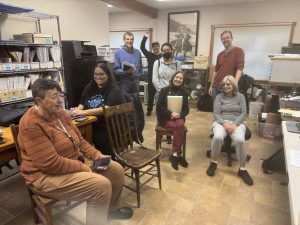
This project team includes gay men, lesbians, transgender people, and straight allies, and varies in age from college until late 70s.
- Roberto Esteves, RRHS Volunteer Archivist and co-lead; a founder of the NAMES Project, which created the AIDS Memorial Quilt
- Shad Reinstein and Jody Lane, Russian River historians and documentarians of Sonoma County lesbian and queer history; oral historians and walking tour leads
- Jane Barry, President of the Russian River Historical Society and former Medical Administrative Assistant at West County Health Centers
- Rhian Miller, independent radio producer and oral historian
- Drew Rose, Training and Education Manager, Positive Images
- Colin Mutchler, RRHS Artist in Residence and project coordinator
Archive volunteers: Kiara Garay, Matthew Galvin, Kayla Holdgreve, Holly Stoufer, Natalie Trowbridge and Fran Levy, who scanned and catalogued the Health Center records.
Sonoma County Library: Zayda Delgado, Geoffrey Skinner, Jaime Anderson and Joanna Kolosov, who trained our volunteers and will steward the collection.
And the dozens of community members who sat for interviews, lent photographs, listened to tapes, and came to share what they remember. Thank you.
Community partners
- California State Library, funder, through the Preservation & Accessibility of California’s LGBTQ+ History grant
- Sonoma County Library and its Here & Queer archive, digitization training and permanent public access
- West County Health Centers, whose Russian River Health Center records anchor the collection
- Positive Images, Santa Rosa’s LGBTQ+ community center, and its QLEAD youth leaders
To contact the project team, please email lgbtq@russianriverhistory.org.


